Friday, June 14, 2013

Alaska Part 1: The Mooses Tooth.

When my friend, Brendan, sent me a Facebook message on the 27th of January saying; "Alaska? May/June? Just looking at the guidebook now."  I did not really take it seriously. Of course I wanted to go to Alaska, but I was not ready for alpine climbing in the Alaskan range, plus I was barely scraping through in Banff. There was no way could I afford a month-long climbing trip to Alaska. The logistics alone were overwhelming, not to mention the prospect of actually climbing there. ‘Alaska’: it's such a powerful word; it has this intimidating mystique about it. Then you couple the words, ‘Alaska’ and ‘climbing’ and my stomach churns. All I can think about is reading about Mark Twights epics in 'Extreme Alpinism'.

After talking to a few people, securing a loan from my ever loving and supportive family, breaking the trip down into achievable chunks and letting my psyche grow more and more, I came to the realisation that it was a possibility. Within a week, I had told Brendan that I was committed and that we had to make it happen. We decided that we would like to climb steeper, more technical lines, as opposed to what the majority of people go to Alaska for - The West Buttress of Denali; simply a walk at altitude. After both looking through the guide book and talking to friends who had climbed there we quickly set our sights on the Mooses Tooth. We wanted to climb two routes on the South Face, 'Shaken, Not Stirred’ V, AI5 and ‘Ham & Eggs’ V, 5.9, AI4'. These are two beautiful couloirs that rise steeply to the summit ridge. Having spent more than seventy days climbing waterfall ice in the Canadian Rockies over the past two winters, I was so excited to put my new found skills and strengths to use in the Alaskan Range.

 With Brendan living in Australian and myself in Canada, we organised the trip and hashed out the logistics through emails and the odd broken Skype conversation. Brendan and I decided to write sponsorship propositions to a few companies, not because we were doing anything new and amazing, far from it, but more because we were both interested in learning about the process of obtaining sponsorship for future expeditions and were excited about the prospect of free swag. Trips like this are expensive and even a few hundred dollars worth of kit can make a big difference. Patagonia Banff very kindly sponsored our trip, giving us some great pieces of technical clothing, including a M10 Jacket, (an incredibly lightweight alpine climbing shell) and the all famous R1 Hoody.


We met in Anchorage on the first of May, I flew there with a good friend of mine, Kris, who was also heading to Alaska for a climbing trip. Twelve hours before I was due to flew out of Calgary I stacked my bike, resulting in six stitches in my head and a very bad case of concussion. With my head pounding we decided not to rush heading into the mountains, instead we spent two days in Anchorage running around getting everything we needed for our trip. We hired a satellite phone, bought $500 worth of food and picked up the last pieces of equipment from various gear shops. On the third of May we took a shuttle to Talkeetna; the gateway town to the Alaskan Range for all climbers. Talkeetna is known as the "quaint little drinking village with a climbing problem". We asked our shuttle driver to take us straight to the Talkeetna Air Taxi office, as we were scheduled to fly into the mountains the following day and wanted to check in as soon as possible.

Brendan and I jumped out of the van and headed for the TAT office, dodging giant puddles on the way, a result of a heavy snow season and a spring that was reluctant to arrive. Upon opening the doors we saw Steve House and Vince Anderson chatting away to one another.... yes, we were definitely in Alaska...

 We met the TAT crew, who told us were we could weigh all our gear and tag our bags. After filling out our expedition paperwork and aptly calling our expedition team the "Ginger Ninjas", we headed over to the Park Rangers Office to register our expedition, pay our park fees and pick up our ‘Poo Pot’ - a small container that Brendan and I would intimately share for the next two weeks. With the weather forecast looking uncertain, we were told that with luck, we would fly in the following day. We spent the afternoon weighing our gear and sorting food - the total combined weight coming in at 325lbs! (147kgs)


Hearing that the TAT bunk house was very busy and we would likely be sleeping on the floor anyway, we decided to sleep in the weigh station. There were some wooden beds upstairs that we could lay our sleeping mats out on. That night we watched the climbing film, ‘The Moonflower’, and got excited when the people in the film were packing their bags just downstairs from where we were sleeping right there and then! The next morning we woke to grey skies.  Not hopeful about flying into the mountains, we walked over to the TAT office. They informed us we were on standby and told us to check in by 10:00. Perfect! It was time to go and eat at the famous Talkeetna Roadhouse. After stuffing ourselves stupid with food and drinking bottomless coffee we wandered back to the TAT office and were greeted with good news, we were flying in that afternoon! A few hours later and we were high in the sky, aboard an ‘Otter’, a small ski plane that managed to fit seven climbers, a huge amount of gear, food and of course our pilot, the legendary Paul Roderick.
Talkeetna Air Taxi Otter
Getting psyched flying in.
The flight in was both awe inspiring and intimidating. It felt totally surreal; like I was watching someone else sitting in a ski plane, flying into the Alaska Range. Upon landing, we jumped out of the plane and started unloading our kit; making a chain where everyone passed bags to one another, throwing them in separate piles on the glacier. We landed on the Root Canal glacier, directly underneath the South face of the Mooses Tooth: WOW! I had been staring at images of this mountain for the past few months and now, I was standing beneath it, I remember laughing to myself; feeling so happy.

Just a little bit excited, Ham & eggs Couloir behind me.
Our ride, complete with Kangaroos on the plane with Ham & eggs Couloir rising behind.

Once we had piled our gear, we strapped on as much as we could to our sleds and started hauling our gear across the Root Canal glacier. We were only relocating a few hundred metres from where the plane had dropped us off! Fearing the huge ice fall that claimed the lives of two climbers in 2011, we walked as far out of the way of the ice fall as we could, setting up camp a short way up a mellow rise on the glacier. Digging out space for two tents, a kitchen, a toilet and a hole for the meat we needed to freeze is no easy task and took us around five hours.

View from the kitchen. Denali in the background.
Home.
Kitchen.
Staring at Denali, light at 11PM.
After setting up camp and brewing up a couple of hot chocolates, we walked around camp and got to know our neighbours, anxious to get recent conditions from parties who may have just climbed both routes. We met well-known mountaineer, Gerlinde Kaltenbrunner and her husband Ralf Dujmovits. They had been on the root canal for four days and had been waiting for calm weather to climb ‘Ham & Eggs’, but had not been so lucky; they were trying to acclimatize and using these as warm up routes for the Cassin ridge on Denali. They flew out the following day without having climbed anything. We decided on having a rest day, as we were quite tired from travelling and my head was still pounding from concussion. The weather was splitter and it was hard to sit around doing nothing while these incredible routes were rising directly above us! That morning we did the social rounds and found out what other parties were planning on climbing the following day, after all we did not want to be on the route with any other parties, if we could avoid it. It appeared that ‘Ham & Eggs’ was the choice for two parties, with no one attempting ‘Shaken, Not Stirred’. Even though it was the harder of the two routes, we decided we would take advantage of the good weather and lack of traffic and climb ‘Shaken’ first. My incredibly awesome brother, Nick, was texting us weather forecast updates on our satellite phone every morning and night. It was calling for light winds, overcast skies and lows of -20c. It would be a cold start, but we were in Alaska, during an unusually cold year, so a cold start was to be expected. That afternoon, we walked over to the base of ‘Shaken, Not Stirred’, and then dropped off one of our ropes and most of our heavy climbing equipment. We wanted to try and get a good look at the route, lingering cloud and the laughable zoom power of our $20 monocular made it a little challenging...
Scoping Shaken, not stirred.
  It was so hard to sleep that night, it was light enough outside to read a book until midnight, so sleeping was a challenge, especially the night before one of the most exciting and challenging alpine climbs of my life! Also, it was very cold; I was wearing a big down jacket, laying on three sleeping mats and wrapped in two sleeping bags. I was warm enough, just anxious and excited. I think I managed two hours of broken sleep that night, at best. The alarm went off at 03:30, giving us an hour to crawl out of our "warm" tent, eat breakfast and gear up for a 04:30 departure. It was fucking cold, I mean, really fucking cold! I have had many early morning winter starts whilst ice climbing in Canada, so I'm no stranger to cold mornings but shit, this was hard. I had to take off my gloves to carry out the finer tasks like lighting the stove and lacing up my boots. As soon as I took my gloves my hands would sting violently, screaming for me to put them back on. I totally convinced myself that I would wear my puffy synthetic pants on the approach and climb with them all day, until the sensible, slightly more experienced John spoke to me and reminded me that if I did so, I would overheat, sweat horribly, soak my base layers through and be even colder for the rest of the day.
First pitch of Shaken, not stirred.
Low on Shaken, not stirred.
Being Alaska in May, it was already light enough at 04:30 to travel without a headlamp. We roped up and crossed the root canal glacier, listening to the snow squeaking and crunching underfoot. Every few minutes I would stop and swing my arms a few times, desperately trying to force blood into my hands.

We arrived at the base at 05:00 and adjusted the rope, switching from glacier travel mode to pitched climbing. We decided to block lead; a technique we thought wise to use as it would help keep us both warmer. My toes would go from a state of numbness to a state of intense pain, known as the ‘screaming barfies’. It is a sensation of overwhelming pain, caused by your hands, or feet, getting extremely cold from a standing around, then when you start moving again, the blood rushes back into your extremities, causing a intense stinging pain (imagine someone stabbing your finger tips with thousands of needles and you will come close to understanding) and sometimes making you nauseous. The first pitch involved a small awkward move to gain a low angled but thin sheet of ‘snice’, very mellow but awkward. There were no options for protection before this move except for a laughable piton, which I placed anyway. I decided to bash a snow stake into the firm snow, before the step, after all, if I blew this move I would slide 50 metres down into the bergschrund: not ideal! I took out my snow stake and bashed, once, twice "Ping". My hammer broke off my axe and flew down the slope, great start to the day! I moved a little higher, cleared some snow and found a bomber #1 camalot placement which gave me the confidence to make the awkward move.


*lower pitches of ice.

Brendan on the sharp end.
Loving life
*Lower pitches.
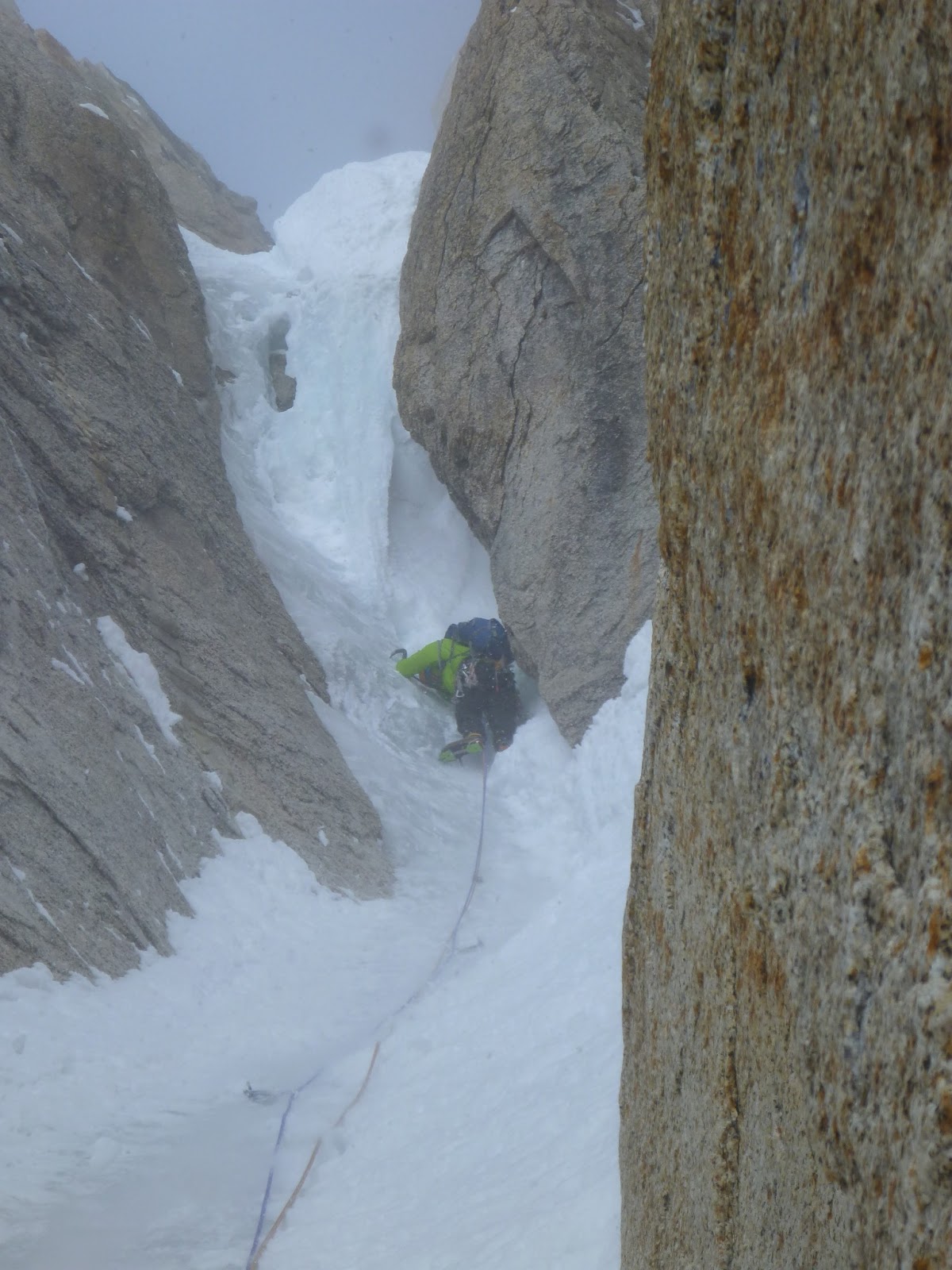
 As the day went on, we slowly warmed up, but not much. We simul-climbed all the steep snow pitches and pitched the ice. The ice was incredibly fun and varied, from shoulder width narrow ice ribbons to short, but steep and in some places overhanging ice bulges. We were able to move fast while simul-climbing, placing ice screws, rock pro and clipping old fixed rap anchors as we went. We had every flavour of ice; dinner plates, sticky Styrofoam and unconsolidated snice.


*The famous 'Narrows'
*Steeper than it looks
*Brendan catching some sun
Beautiful climbing!
Both Brendan and I were convinced we had climbed the crux, although when I turned a corner on one of the snow pitches, I looked up and realised we had not. Compared to some of the frozen waterfalls I had climbed in Canada, it was nothing, but there were a few things at play here; I was running on little more than two hours sleep; my head was pounding from exerting myself with a bad concussion; due to a number of injuries before the trip, this was the first real exercise I had done in six weeks; I was wearing a pack; I was dehydrated and at this point, we had been on the move for around 12 hours. I was both excited at the prospect of more steep ice, but at the same time totally demoralised and struggling with a contradictive mix of emotions. Wanting it to be over and longing for easier angled snow slopes above; I launched into the ice and worked my way up to the top of the flow. There was a small hole in the ice curtain and this feature provided nice stemming. There was literally one metre of steep ice to go. I swung my right tool, adjusted my feet and pulled my body up... “ARGH!” My bicep tendon spasmed and my hand, without my brain telling it to do so, instantly let go of my ice tool. I gripped hard with my left tool, tensed my core and managed not to swing off balance. Fuck, what happened? I grabbed my tool again, convinced it was nothing and tried to weight my right arm again. Same thing, the tendon in my arm felt like a steel cable that was about to snap. Seriously? One metre of this final ice bulge left and I can’t even finish it? I tried a few more times, adjusting my position but nothing was working; I could not weight my right arm. I tried aiding on ice screws but the quality of ice was inconsistent and seemed like it would take a long time, especially when I only had one working arm. I placed an ice screw, clipped in and proceeded to kick a hole through the six inch thick ice curtain. After twenty minutes I managed to create a hole big enough to crawl into. Now I was squashed underneath the giant frozen chock stone, it was a creepy yet strangely beautiful position. I knew it was not going anywhere but all I could think about was the rock moving and being squashed in a tomb of ice and granite. I placed two screws and brought Brendan up to finish the final metre of the crux, far from stylish but a bad fall avoided. For a few short moments I was upset at what happened and my ego was damaged, but I quickly reminded myself of where I was and pushed away any negative thoughts. I remember Brendan saying to me, "You made a good decision; remember it’s when you stop making decisions that shit goes bad." That will echo with me for a while.

*Tired.

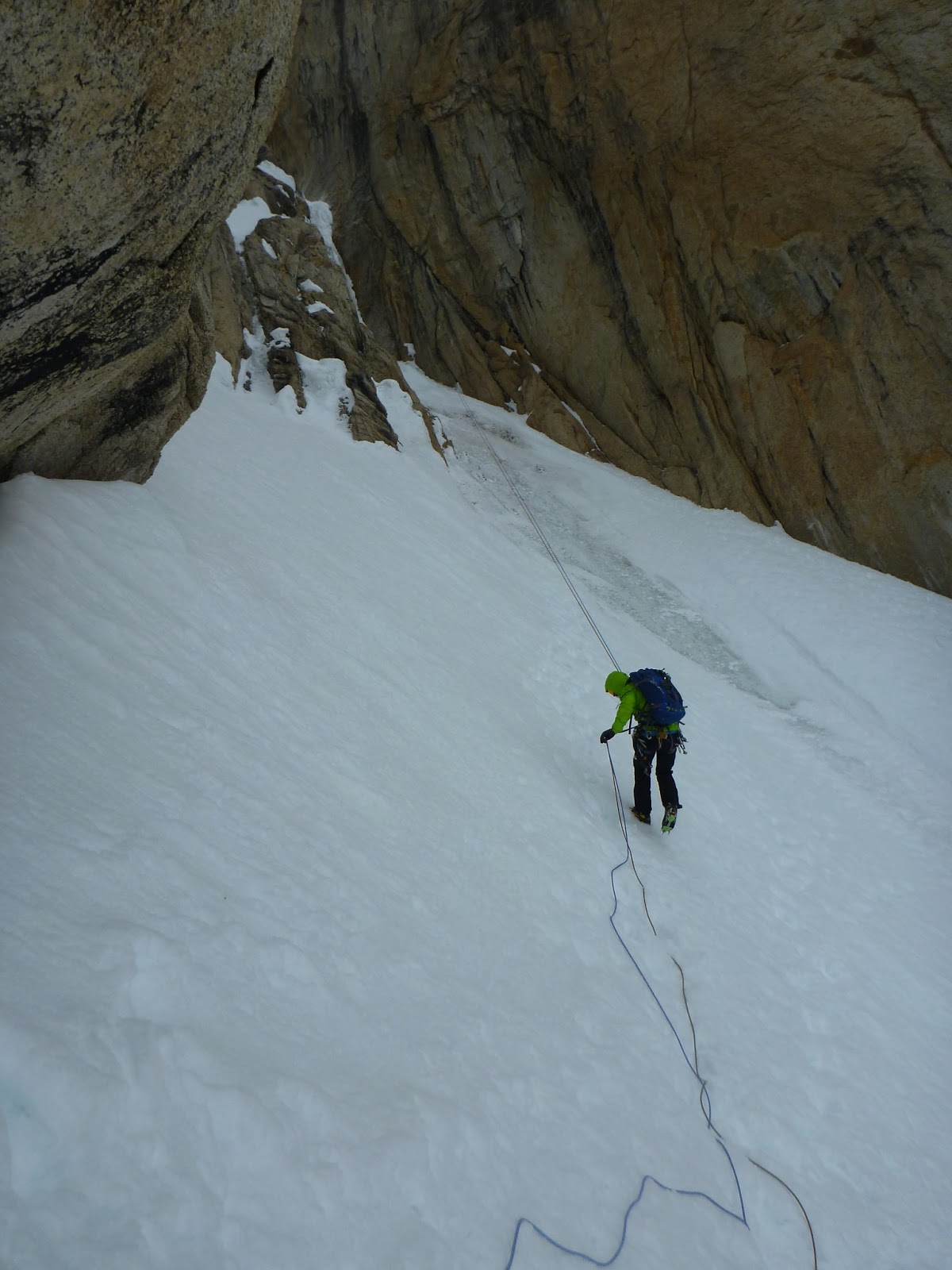
 After the crux we had about six pitches of steep snow to Simul-climb, a 10 metre traverse and then few more rope lengths of steep snow to Englishman's Col, which was to be our high point. It was cold and the higher we climbed the more exposed we became to the strong winds, the hairs inside my nose were frozen and felt like coarse wire.We topped out after 13 hours of continuous climbing, a pretty mellow day in the world of alpine climbing. Upon reaching the ridge there was about 15 metres of visibility and the wind was gusting around 50+kph. With the wind chill I estimated the temperature to be at least -20c, probably colder. I was wearing five layers, two of which were a lightweight synthetic puffy (Patagonia Nano Puff) and a big down jacket (Patagonia Fitzroy), and I was still shivering violently. I had only decided to climb with 1.5 litres of water and did not drink enough before leaving base camp or on the approach. Dehydration was a big factor in how cold I was. Brendan and I looked at one another, and we instantly knew what each other wanted to do. We turned our backs on the west summit and started our descent. It took us three hours and 18 or more rappels to reach the glacier. The descent on both Shaken not stirred & Ham and Eggs couloir are very friendly. There are many fixed rap anchors from over the years, mostly comprised of old pitons and nuts. On our way down we would bounce test the anchors, before transitioning from one rappel to the next, ensuring they would not rip on us.


*Traverse pitch before the final rope lengths to the col.
*Brendan coming up to our high point.
*Brendan rappelling into the abyss.
Upon reaching the glacier conditions had improved and the bad weather seemed to be localised around the summit of the Mooses Tooth. I was a little disappointed we had not pushed for the west summit but with such poor conditions up high and thinking back to how cold I had been, I was at peace with our decision pretty quickly. We kicked off the crampons, strapped on the snow shoes and headed back to camp.

On the way back to camp, Brendan mentioned his toes were quite painful. Once we reached camp and took our boots off he realised both his big toes were red and swollen and his toenails had turned black. Front pointing for a thousand metres for 13 hours in -20c will not do wonders for the feet. There just so happened to be a Denali Park Ranger & a doctor who were climbing together on the root canal. Brendan spok
e to them about his toes. He had badly frost nipped (first stage frost bite) his toes. The Doctor said, and I quote: "As a doctor I should tell you to fly back to Australia, sit on the warm beach and drink beer, but as a climber I know you're not going to do that. Take care of them, keep them warm and be careful with the rest of your climbs, don't push it." We were in single boots, despite double boots being more common, singles are usually fine for the lower elevation climbs within the Ruth gorge but it was unseasonally cold this year. With Brendan's toes feeling worse for wear, we decided to rest a few days before climbing Ham & Eggs. We spent the days reading, eating, sleeping and discussing future expeditions. Friends came and went and our kitchen became a social hub for surrounding camps. Consuming whiskey and salami, we all shared stories from different walks of life; guides, literary agents, artists, Black Diamond engineers, sponsored athletes and modern climbing legends were amongst the motley crew that we passed time with.
*Twid Turner, Bill Brody, Bruce Ostler & Freddie Wilkinson hanging at camp.
*Twid Turner & Freddie Wilkinson.


*Crampon Cheese

*Cooking dinner.

*Dinner
 *Still very light out..
* Bumped into Patagonia Ambassador, Vince Anderson.

After giving Brendan's toes a three day break we decided to climb Ham & Eggs. Ham and eggs was very similar to 'Shaken, not stirred'. The main difference being there was less steep ice on Ham & eggs and more snow climbing. We climbed Ham & Eggs in nine hours camp to camp. Brendan said he was happy for me to lead most of the ice as I would probably move a bit quicker. We fired up the route, this time with my right arm feeling fit and strong, no issues! When we reached the summit ridge, we had similar conditions to when we topped out on 'Shaken, not stirred'. Poor visibility and strong winds. We had spoken to other parties who had given us beta on reaching the main summit from the top of the route. It was taking parties around four hours to get to the summit and back to the couloir, involving precarious corniced ridge travel and somewhat sketchy snow climbing. With Brendan now sporting sore and swollen toes, we knew it would be unwise to continue to the summit. We started our descent and rappelled the route in a little over two hours.

Here are a few shots of Ham & eggs...

*Brendan coming up on Ham and Eggs.
 *Brendan after battling through spindrift.
*Brendan taking us up the last little flow of ice before the final snow slopes.
 *First Crux
 *Second Crux.
*Loving life.
*At the belay.
 *Tired & Feeling unfit after six weeks of rest due to a number of injuries.
 *Rapping Ham & Eggs.
*Final traverse to get back down to the glacier, spooky soft snow.

When we arrived back in camp that afternoon we heard that the weather was closing in the day after next. We wasted no time in calling Talkeetna Air Taxi on the satellite phone and quickly organised a flight down into the Mountain House Base camp for the following day.We decided to fly down instead of walking as we had three weeks worth of food and equipment, which meant travelling through the ice fall with overloaded sleds would be slow and dangerous. The next day we packed up camp and spent most of the day sitting on the glacier, waiting for the plane to arrive...one chapter of the trip was over and the next was about to begin...

We are currently putting together a short film of our trip, in the mean time here is a little teaser put together by Brendan Maggs. 


Thursday, April 25, 2013

Pre Expedition Injuries...


Six weeks ago I was bouldering in the climbing gym at the Banff Centre. I started with my usual routine; stretching, traversing on big holds then cranking on harder problems, slowly increasing the intensity. I was trying an awkward compression problem in the corner, which involved smearing both hands on desperate slopers, pulling outwards and bumping both hands up to equally poor features all the while edging my feet on micro foot holds. I slipped off several times, frustrated, I pulled on one more time and threw my right hand high, caught the sloper and stuck it for a few seconds before falling, but not without a tearing sensation in my right shoulder...fuck. I decided to call it a night for bouldering, shrugged off the injury and went upstairs to the gym and sat on the exercise bike. This trivial plastic boulder problem drastically changed the next six weeks...


The following evening I was sitting in the Banff Mineral Springs hospital waiting for the doctor to come and tell me if I had ruined my rotator cuff or not, knowing this injury often meant surgery and months of rest and rehab, this was not a option when I had just booked flights to Alaska for a month long alpine climbing trip. 

The news was better than I dreaded but not as good as I hoped for...I had torn soft tissue in my shoulder and inflamed my bicep tendon. I was told I had to rest for a minimum of six weeks and that with physio, acupuncture, strict icing and luck I could be ready for Alaska. The first hurdle was accepting that I had just lost the last two months of my Ice climbing season - not a big deal in the large scheme of things but a pretty big deal for someone who traveled to the other side of the world to focus on Ice & mixed climbing. This was also very frustrating as I had spent the previous few months building my strength and confidence on steep ice and mixed routes, at this point I finally felt ready to tackle some bigger, more fulfilling objectives like French Reality, Nemesis and Silver Lining.

Once I had accepted that my season was over (not easily done) the worry of not healing in time for Alaska set in. I had just booked return, non refundable flights to Alaska and told my partner to go ahead and book his. I knew I had to pull out all the stops in order to allow my shoulder to heal. Nobu, a friend of mine, kindly introduced me to a Japanese acupuncturist. It was a funny afternoon, with me not speaking much Japanese and her the same amount in English, Nobu translated for us and I had my first acupuncture experience. 
It's hard to say exactly what is responsible for healing when there are many contributing factors, rest, ice and physio etc, but I definitely felt a considerable improvement in pain and an increased range of movement after my session of acupuncture.


Since then my rehab has consisted of physio, a course of strong anti-inflammatory drugs, ice, thera-band exercises, more acupuncture, stretching & many visits to the steam room. 

In five days I fly to Alaska...my shoulder is far from 100% but the constant pain has been dulled and my range of movement is great. I'm not in any shape to be cranking on hard mixed routes, but our routes will require more endurance in the legs & lungs than the upper body anyway. I wish my shoulder was the only part of my body breaking down but its not...with a bunion on my little toe, locked knee's due to very tight IT bands and a wisdom tooth slicing away at the inside of my mouth...I don't exactly feel ready for a month in the mountains... but only time will tell!

Today is my last day of work and I will spend the next five days booking ski planes, going to physio, buying the last of the equipment I need, studying maps & climbing objectives and packing an inconceivable amount of gear into three seemingly small bags...


Wednesday, April 17, 2013

Falling Ice

1st of April, 2012. Most ice climbers have hung up their tools by this stage, and perhaps Sylvain Riopel and I should have done the same. I had only climbed with Sylvain once before, the weekend prior. We went and climbed Whiteman Falls & Redman Soars, a classic WI6 Ice route followed by a technical 5.9/WI4 mixed line situated immediately to the right. These were the hardest lines I had ever climbed and was stoked to finish my first season of waterfall ice with such challenging classics. We had a great day of climbing steep ice, sharing stimulating conversation and enjoying cold beers back in Syl's van. Such a good day was had that we decided to head out again the following Saturday.

Whiteman Falls

*Sylvain Riopel coming up pitch two of Whiteman Falls.
*Climbing through a ice tunnel on pitch 1 of Whiteman Falls

We had agreed to climb Pilsner Pillar, another mega classic WI6 route situated on the northwest flank of Mt Dennis, behind a small town west of Banff called Field. Sylvain was driving from Calgary and was due to pick me up at 8AM. We pulled over on the road next to the trail, sculled what was left of our coffee, pulled on the boots and started slogging up to our climb. Despite being the 1st of April, winter, as it does well in north America, was lingering and the temperatures justified being there. It was -5c when we left the car and with overcast skies and low avalanche hazard we justified attempting this route so late in the season. While approaching the climb I looked up and noticed a party of three other climbers climbing the mixed lines through the middle of the ice, it happened to be Jon Walsh, Andrew Querner & Rafal Andronowski. They were filming Jon climbing like the bad ass that he is for a Arc'teryx advert. It was super inspiring watching Jon climb with incredible ease and efficiency through steep mixed ground and overhanging ice.


*Sylvain approaching Pilsner Pillar.


*Pilsner Pillar

Pilsner Pillar is probably not the most apt name for the climb in the conditions we were attempting to climb it in, the centre pillar fell down a few weeks earlier and the only way to reach the ice was to battle our way through steep mixed ground, the easiest path going at M5. We decided on tackling the right hand side, on a route which I think goes by the name of Traditional Ale, M7. Sylvain, psyched for the lead, started racking up. To gain access to the ice above you first had to climb 10 metres of steep rock, with a small traverse. The first bolt was a few metres off the ground, though luckily there was a big heart shaped feature below the first bolt which would offer a comfortable place to clip from. Once Sylvain was in reach of the first bolt he matched his hands on the rock feature, rest his tools over his shoulder and went for a quick draw. As soon as he took one hand off the rock the entire  feature that he was lay backing off tore off the wall. He acted quickly and landed about as gracefully as humanly possible. He managed to turn 180° mid fall and land in knee deep snow and avoid being crushed by the size-able chunk of rock, sadly this was not a soft enough fall and he tweaked his knee which was to end his day of climbing and see him limping for weeks to come.


*Sylvain looking happy not to have been crushed.

With Sylvain now injured and unable to climb he offered the lead to me. I insisted we call it and day and get ice on his knee asap but he swore he was fine to belay and would love for me to give the route a shot. Feeling a little overwhelmed I nervously took the draws & ice screws from Sylvain and started racking up. As soon as I started up the climb I was over gripping my tools and getting pumped fast, having not done much mixed climbing before I was soon hang dogging my way through the bolts. After clipping the final bolt I felt scared but ready. I placed a .75 Camalot in a crack & clipped a rusty old piton before stemming across to the ice, knowing the first few metres would offer nothing but psychological protection.  The ice was nice and sticky, though I knew I had to treat the dagger features I was stemming on to with caution and tread lightly. Placing my front points rather than kicking and gently flicking my wrists to gain purchase with my ice tools.

Once I gained the halfway ledge I clipped a V-thread with a extendable draw and traversed left to the main curtain of ice. Behind the curtain I found bomber Ice screws that helped instill me with the confidence I needed to finish up the last steep section. The ice was very hospitable, what ice climbers generally refer to as "Hero Ice" where you can swing your tool once and gain a solid stick. This styrofoam type texture is generally attributed to the ice baking in the sun, which at this stage had burnt off the weak cloud cover above and was weighing on my mind.


*Pilsner Pillar, photo by Andrew Querner.

I finished up the ice, feeling super stoked to have gotten to the top but was more than ready to get away from this giant ice curtain and its refrigerator sized daggers as quickly as possible, especially now that the sun was out. Jon & Andrew had just made a V-thread and rappelled a few minutes before I arrived at the top. Without giving it much thought, I secured myself, pulled the ropes and rigged them for rappel. If I had stopped to think I would have realised that where I was rappelling from was about 10 metres left from where I originally started the climb, and where my quick-draws, that I had to retrieve, were still hanging.
At first, things went fine. I rappelled down, cleaning my ice screws as I went. When I got to the ledge, I walked right and clipped my ropes through a maillon (oval shaped metal) as a redirect and continued to rappel. The redirect was helpful to get more in line with the remaining gear I had to clean but did not get me as close as I would have liked to my last remaining quick-draw. To help me reach I asked Sylvain to pull on my ropes in a attempt to get me closer. What we did not realise is that directly above me, my ropes were passing over a refrigerator sized free hanging pillar of ice. The tension caused by the ropes being pulled was enough to cause the pillar to break off. When the Ice fell I was beneath it but miraculously it only managed to graze the left side of my body. Considering it probably weighed close to 300kg's I feel very grateful it did not hit me directly. I was in shock, knowing what had happened but not really grasping why exactly. I immediately felt pain in the left side of my body and looking at the debris below me I knew what had just hit me had been large enough to kill me. I hung limp from the rope, unable to speak at first, more because of shock than physical pain. Everyone was silent, no one spoke. After a few seconds, what felt like minutes, Sylvain and Rafal asked if I was ok. I replied, "Yes, I think so" with a lot of hesitation in my voice. I lowered myself to the ground and fell on my ass, my legs had turned to jelly and I felt shooting pains through my left thigh and arm. After a minute or so I realised I was not totally broken and could in fact bear weight on both legs.

* What was left of the pillar that fell on me.

Rafal, Jon & Andrew kindly offered to assist us back to the road & carry our packs to the car but we felt we would manage. We exchanged emails and waved goodbye. Sylvain and I gathered our gear, happily left the last quick-draw hanging above the chunk of rock that started the chain of unfortunate events and hobbled  down the snow slopes back to the car. We sat in the van, utterly humbled and in awe of how lucky we had been that day. Many lessons were learnt that day, from being conservative with late season objectives, to fully respecting the power of the sun and the immediate effect it has on rhe stability of ice features. Balancing perceived risk, objective hazard and ambition to climb a particular route can be a hard and often unforgiving act. I feel very lucky to have gotten away with only superficial injuries...


*Sitting in the Hospital that evening awaiting X-rays.

Saturday, April 6, 2013

Red Rocks, Nevada.

BEEP BEEP BEEP, went the obnoxious alarm at 5AM. Feeling sluggish from the beers the night before I stirred myself awake. My good friends Sylvain and Sara had kindly put me up in their house in Calgary the night before I was due to fly to Las Vegas via Vancouver. Despite having to go and teach a class of high school students that day, Sylvain kindly woke at the same time and insisted on driving me to the airport, a very kind soul! I was headed to Red Rocks, Nevada for a five week long climbing trip. The flight from Vancouver to Las Vegas was incredible! First humbling sight was Mt Rainier (4,392 m), completely free of clouds, I was able to clearly see its crevasse riddled glaciated slopes.

* Mt Rainier (4,392 m)

 * Red Rocks, Nevada.

For the remainder of the flight I had my head buried in the Red Rocks guide book, making a list of routes I wanted to climb. Just before landing in Las Vegas we flew right over Red Rocks itself, it was a incredible sight. I had definitely downplayed the proportion of this place in my head and I was again humbled at what lay beneath me. A couple from Texas asked me what the purpose of my trip was, I replied "I'm camping in the desert for five weeks to climb in those sandstone mountains. I told them I might check out the strip once or twice but aside from that it was tent life for me. They nodded, smiled and said a familiar line of "Oh a rock climber, you're crazy". Once I landed in Las Vegas and made it through the grueling, ever welcoming, process of American Immigration I met up with a friend and climbing partner from the Bow Valley, Samuel Lambert. We had organised to climb together for five weeks in Red Rock Canyon. "Red Rocks" as it is refered to by climbers is series of sandstone peaks and walls, some rising 3000ft (915m) from the desert floor. After a quick trip to Costco for the cheapest groceries and alcohol one could find anywhere on the planet ($15 for 1.75l bottle of Smirnoff) we drove 24 kilometres west to the Red Rocks Campground. Red Rocks campground is a pretty barren place, beautiful in a sense and not so much in others. Before leaving on this trip a friend had called it "Campghanistan" as it is sandy, windy, hot and there was shooting range close enough that you could often hear gunshots. I had also heard horror stories of tents being ripped out of the ground from the extremely strong winds, intimidated by these stories I had bought 15m of 3mm cord to guy out every possible point on my tent.

 * Home for 5 weeks.

On our second day there we had some interesting weather...despite holding true to its forecasted temperature of 21°c it decided to snow on us halfway up a 6 pitch route. The air temperature difference at our elevation compared to the clouds was inconceivable - snowing when not thirty minutes ago I was sweating without a shirt on? Luckily it was a easy grade and we finished up the route quickly, though not without getting quite cold on a few of the belays. Sandstone is also quite dangerous to climb when its wet as it becomes very fragile, very fast. This made our descent a little interesting but far from epic. I was already feeling a bit crook upon arriving and after our snow day in the desert I came down with a bad cold, it did not help it was dipping below 0°c at night, nothing my sleeping bag could not handle but not ideal when already battling a bad cold. I spent the following 5 days sleeping, reading Jack Reacher novels and drinking copious volumes of vegetable Juice in the hopes I would be back on the rock soon.


* Hanging off a vertical wall getting snowed on in the desert.

I was soon feeling better but not without a week "wasted" recovering, very frustrating when everyone around you is getting out and returning to camp at night with joyous tales of the vertical world. A few days after feeling relatively human again Sam and I decided we would climb the mega classic, Epinephrine. Epinephrine is considered one of the best quality routes in Red Rocks and probably one of the most classic 5.9 multipitch routes in the world. I had heard of people getting shut down on this route and having epics trying to get down in the dark, some even sleeping out (when the headlamp was forgotten), waiting to find their way down in the morning. I think the main reason for this is the moderate grade of the climb which might lead people to underestimate the time needed and the true chimney technique required to climb the first five pitches (rope lengths) efficiently and quickly. Epineprine starts off with five incredibly fun chimney pitches, requiring you to wiggle, squeeze, jam, slide and worm your way up. There was the odd bolt for protection and lots of good cam placements a crack at the back of the chimney. Overall they felt very secure and we moved quickly. At one point I lost concentration for a moment and almost slipped though I was enjoying the climbing so much I could not step yelling down to Sam on the belays about how good it was!


* Placing a cam (protection) on one of the lower chimney pitches.

 * Sam seconding one of the lower chimneys.

To move fast we employed block leading techniques. This is where one person will lead a number of pitches in a row, this can speed up a party if the leader still has most of the gear racked on their harness. It saves exchanging lots of gear at the belays in order for the seconder to climb next. It worked well on these pitches as they were quite short and not a huge amount of gear was placed.
Once we cleared the chimneys of the black tower we had continuous beautiful 5.9 face and corner climbing above. It was spectacular, super positive holds, great pro and awesome exposure!

 * Great exposure on a hanging belay on the upper pitches of Epinephrine!


 * Sam Seconding upper corner pitches of Epinephrine.

The final leg of Epineprhine involves a few hundred feet of 3rd & 4th class climbing (scrambling with consequence of falling) which Sam and I simul climbed. Simul climbing is another technique for moving fast, it is where both climbers are moving at the same time, usually with about 30 meters (varies depending on terrain) of rope between the two. The leader will place gear and when the second arrives at gear (protection placed in the rock) he will take it out. The idea is that there is always numerous pieces of protection between the two climbers so in the event of a fall, the gear will catch either the leader or the seconder. It is important for the seconder to not climb too fast and allow too much slack rope to come into the system, if this does happen then the leader has a greater chance of taking a big fall. We summited 5.5 hours after leaving the car, we were stoked to move so quickly and it filled me with the confidence I needed to feel ready for our main objective of the trip and what was to be the longest rock route I have ever climbed.

Resolution Arete, to my knowledge, is the longest route in Red Rocks Canyon. It follows the prominent turreted arete, centre right of the north east face that runs direct to the summit of Mt Wilson. It stretches a mighty 2500ft  in length and is a varied, challenging line, with many different styles of climbing. Retreating off this route would be very hard as it is a wandering line with no fixed anchors. Once we committed to the climb we had to reach the top. It holds challenging route finding with many very poorly protected sections and seldom sees ascents when the days are short and being early December our days were very short.The sun was rising around 6AM but the sun was setting just after 5pm. This allowed us 11 hours of light to climb the route. It is graded 5.10, A1 with a total of 1 bolt on entire route. The short days, old school grades, long runouts with poor gear and the challenging route finding were all weighing on my mind and making me quite nervous. Not to metion that at night it was often dipping to below 0°c. The prospect of spending the night on the wall was not one that I was excited about, though we prepared for it by stuffing two super light weight puffy jackets into our bullet packs, just in case we did end up sleeping halfway up the route.


*Standing at the base of Resolution Arete, watching the sun rise over Las Vegas.

 * Resolution Arete is the prominent turreted arete that runs centre right of the face.

To increase our chances of returning to our tents on the night of the climb we decided to familiarize ourselves with the approach and dump as much heavy equipment at the base of the route the day before. We carried in water, food, ropes, shoes and the climbing gear and left it at the base of the climb. We were now familiar with the approach, so doing it in the dark would not be an issue.
We set the alarms for 3AM. It was hard crawling out of the warmth of a giant down bag and pulling on smelly, sandy clothes in the freezing cold. I tried to force down our usual power breakfast which consisted of a Burrito wrap smeared with peanut butter and then loaded full of trail mix and M&Ms. It was so hard to eat, I wanted to vomit. In the end i ate a huge chunk of salami and sculled 1 litre of water.

We set off in the dark across the desert, moving fast and breathing hard with cold plumes of air catching in the light of our headlamps. The first segment of the approach was one hour of walking across flat desert through prickle cactus and ankle scratching bushes. After the flats the scrambling began, not hard but consequential enough to require one to focus, as a slip would result in serious injuries. We reached the base of the climb after one and a half hours - just as the sun was rising, perfect timing!

We sculled another litre of water, leaving only 1.5 litres on our pack and geared up for the climb.
The first pitch involved a run out traverse over a gap between two walls of rock, meaning when you looked down, even though you had just started the climb, there was a few hundred feet of exposure beneath you, pretty wild! It was obvious from the first pitch that this climb would require a strong head and a calm state of mind, the climbing was awkward and sandy and the gear was run out. At one point I was bumping a #4 Camalot for fifteen metres up a crack. Sam and I block lead sections, simul climbed some of the 4th and 5th class terrain and swung leads throughout the route. The crux of the climb is a 5.11d finger crack through a roof, Sam, the rope gun (stronger climber) was going to try and free this pitch but quickly decided to aid it like most other parties do. I was at a gear belay, hanging off a vertical wall 5 metres below him, slightly concerned about a factor 2 so I was very happy when he pulled out the slings and started aiding the roof. The climb flowed well and we moved very quickly, after all we had been climbing multipitch routes with each other consistently for the past four weeks. It is enjoyable to be so tuned in with one partner, knowing exactly how one another moves, what the other is doing or how long they will likely take even after losing sight of them.


*Sam aiding the A1 Crux.

 * Me seconding high off the ground on Resolution Arete.

 Sam & I looking tired on a very windy summit of Mt Wilson.


 *Hanging gear belay below the Crux Roof.

Despite getting slightly off route a few times and feeling the fatigue of five weeks of climbing, we managed to knock this route off with few headaches. We summited Mt Wilson fifteen minutes before the sun set and were ecstatic to have completed the route. Alas the risk of sleeping out that night was not yet behind us as we still had to descend the backside of the mountain and find the tree rappel that would put us in the valley that we would follow back to the car. We quickly woofed down a few power gels and half a very soggy subway sandwich, replaced the climbing shoes for lightweight runners and started running down the backside of Mt Wilson. Just as it was transitioning from twilight to pitch black we found our tree and abseiled 30 metres into the drainage. For the second time that day we switched on our headlamps and started the two and a half hour walk back to the road. We kept our spirits high by cheerfully reminiscing about the highlights and scariest moments and what takeaway we would reward ourselves with when we drove into town that evening. By the time we made it back to the car we had been awake and on the move for seventeen hours. I am so happy to have climbed Resolution Arete, a big adventure with a great friend, which filled me with a huge amount of confidence and fulfillment which I still feel to this day.

After spending five weeks in a sandy tent I was pretty ready for a comfortable bed and easy access to a shower. My brother had emailed me a few weeks earlier saying he wanted to buy me a belated birthday present and told me to pick a hotel to stay in for my last night in Las Vegas...very lucky to have such a kind big brother! What a contrast! From a sandy tent to a double queen room on the eighteenth floor of the Spa Tower in the  Bellagio! Sam and I were stoked...we did what must be done and went out that night on infamous "Strip". A few good friends from the Red Rocks camp ground came into town and we spent the night wandering from one casino to the next, pretending the play the pokies and milking the casinos for free drinks. A fun way to end a fantastic trip.